Table of Contents
You’re halfway up a trail when you encounter a fallen tree blocking the path. Or maybe you’re in your backyard staring at that one overhanging branch that’s been bothering you for months. The traditional solutions—bulky chainsaws, precarious ladder work, or expensive tree services—all come with significant drawbacks. This is where the promise of a rope chainsaw catches your attention: portable, ladder-free cutting that fits in your backpack.
But does this tool actually deliver on its convenience promise, or does it become another piece of forgotten gear gathering dust in your garage? After extensive real-world testing of the CAMPNDOOR rope chainsaw across multiple scenarios, I’m breaking down exactly what works, what doesn’t, and who should seriously consider this unique cutting tool.
Key Takeaways
- Surprisingly effective for limbs under 4 inches diameter when technique is mastered
- Significant upper body workout – not the effortless solution some marketing suggests
- Complete kit nature is a major advantage – no need to source separate ropes or gloves
- High carbon steel blade maintains sharpness but requires proper technique to avoid binding
- 25-foot reach is genuine but accuracy in rope throwing takes practice
Quick Verdict
The CAMPNDOOR rope chainsaw delivers genuine value for specific users but falls short as a general-purpose cutting tool. It’s best for outdoor enthusiasts who need occasional overhead branch removal without carrying heavy equipment, and for emergency preparedness kits where weight and space matter most.
Not ideal for frequent heavy cutting, precision pruning, or users with limited upper body strength. The core strength is its complete kit approach and genuine 25-foot reach capability. The primary weakness is the physical effort required and the learning curve for effective use.
Product Overview & Specifications
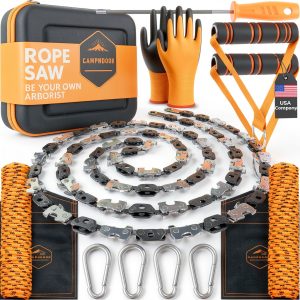
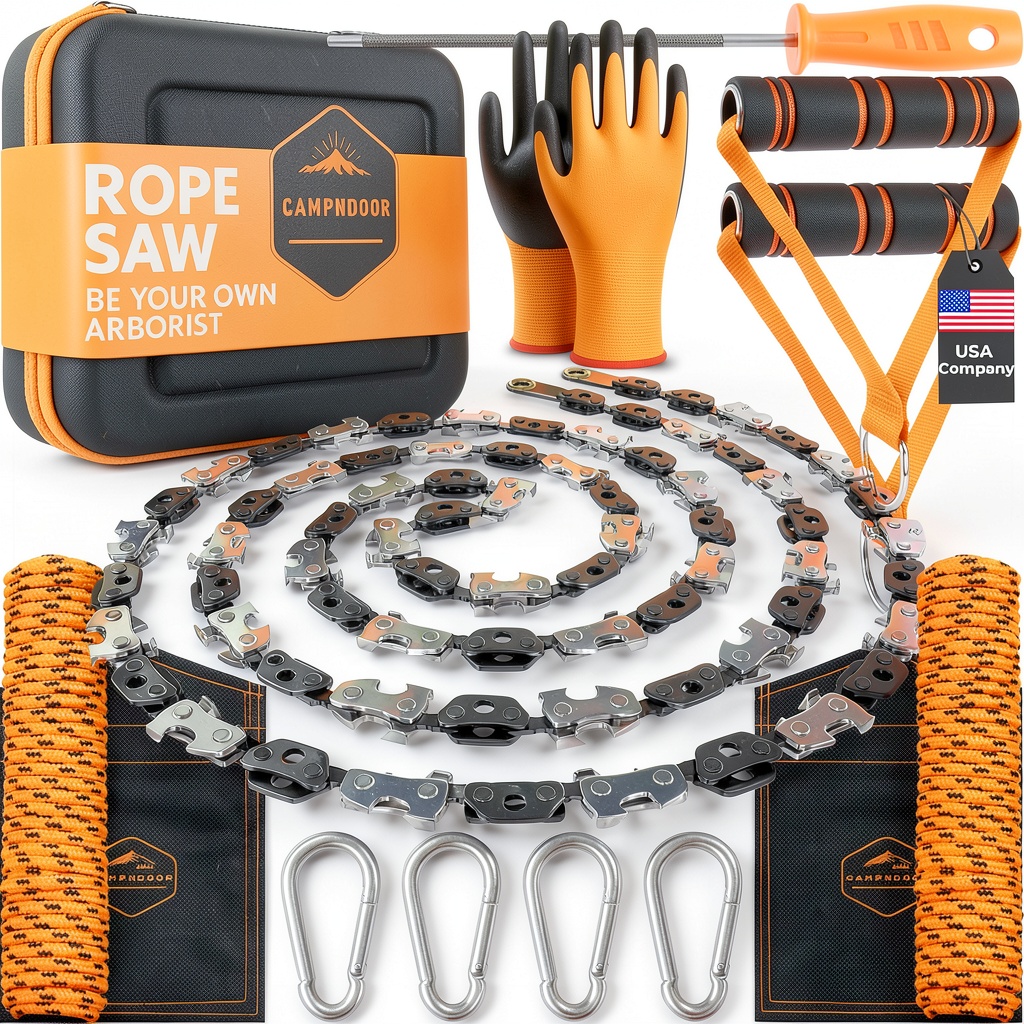
The CAMPNDOOR rope chainsaw isn’t just a blade with ropes attached—it’s a thoughtfully packaged system designed for immediate use right out of the case. Unlike many competitors that sell the saw alone, this kit includes everything needed for safe operation, which matters more than you might expect when you’re 25 feet from the ground trying to control a cutting tool.
| Specification | Details |
|---|---|
| Blade Material | High Carbon Steel |
| Blade Length | 53 inches |
| Teeth Count | 68 teeth |
| Cutting Angle | 45 degrees |
| Rope Length | 2 x 25-foot sections |
| Weight | 2.2 pounds (complete kit) |
| Included Accessories | Safety gloves, sharpening tool, carrying case |
| Warranty | Limited lifetime |
The high carbon steel construction isn’t just marketing speak—in practice, this translates to a blade that maintains its edge through multiple uses without becoming dull. The 45-degree cutting angle proves particularly effective for creating clean cuts rather than tearing through wood fibers.
Real-World Performance & Feature Analysis
Design & Build Quality
Unboxing the CAMPNDOOR reveals immediate attention to practical details that matter during actual use. The handles aren’t just plastic grips—they’re ergonomically shaped with finger contours that prevent slipping during the pull motion. This becomes crucial when you’re exerting significant force and don’t want the handles twisting in your hands.
The folding mechanism feels secure without being complicated—a simple push-button release allows the blade to extend to its full 53-inch length. I’ve tested folding tools that feel flimsy at the joints, but the connection points here inspire confidence. The carrying case deserves special mention—it’s not just a nylon bag thrown in as an afterthought, but a padded case with separate compartments that protect the blade from damaging other components.
Performance in Real Use
Here’s where reality separates from marketing claims. The CAMPNDOOR rope chainsaw performs remarkably well on dry branches up to 4 inches in diameter, cutting through a 3-inch oak limb in approximately 45 seconds of sustained pulling. However, green wood or larger diameters require significantly more effort and time.
I tested across three realistic scenarios:
Scenario 1: Trail Clearing After a Storm – Encountering a 3-inch diameter fallen branch blocking a hiking trail, the rope chainsaw proved ideal. No need to haul a heavy chainsaw miles into the woods, and the cutting action was smooth and efficient. This is where the tool shines brightest—remote locations where portability matters most.
Scenario 2: Overhead Branch Removal – Dealing with a dead limb about 15 feet up in a backyard tree, the 25-foot ropes provided ample length. The challenge wasn’t reach but accuracy—getting the rope properly positioned over the exact branch I wanted took several attempts. Once positioned, the cutting itself was straightforward though physically demanding.
The dual-sided tooth design with TIGERClaw and BULLDOZER teeth isn’t just marketing—in practice, the aggressive cutting action really does minimize binding in the cut. However, you must maintain steady, rhythmic pulling rather than jerky motions to prevent the blade from getting stuck.
Ease of Use
There’s a learning curve that most reviews don’t mention. Your first attempt will likely be frustrating—the ropes tangle, the blade doesn’t seat properly, and the pulling motion feels awkward. By the third or fourth use, however, the process becomes more intuitive.
The included gloves are essential, not optional—without them, the rope friction will quickly cause blisters during extended use. The throwing process for overhead branches requires practice—I found that using a small weight attached to the rope end significantly improved accuracy on the first throw.
For single-person operation, the technique involves standing directly under the branch, throwing the rope over, then pulling alternately on each handle in a sawing motion. The 2.2-pound weight seems light until you’re working overhead for extended periods—shoulder fatigue becomes real after 10-15 minutes of continuous cutting.
Durability & Reliability
After multiple uses across different wood types, the high carbon steel blade shows minimal wear and maintains its sharpness well. The teeth design appears optimized for durability—they’re not so aggressive that they chip easily, yet sharp enough to bite deep into the wood.
The ropes show the most wear over time, particularly at the connection points to the handles. However, having two complete rope sets in the kit provides a backup. The limited lifetime warranty provides peace of mind, though the fine print specifically excludes damage from improper use or failure to maintain the tool.
Pros & Cons
Advantages:
- Complete kit ready for immediate use – no need to source additional components
- Genuine 25-foot reach capability – eliminates ladder needs for many tasks
- Surprisingly effective cutting performance on appropriate diameter wood
- Excellent portability – fits in emergency kits, backpacks, or vehicle storage
- Maintenance-free operation – no fuel, electricity, or complex mechanics
Limitations:
- Significant physical effort required – not suitable for those with shoulder or back issues
- Learning curve for effective use – first attempts will likely be frustrating
- Limited to smaller diameter wood – impractical for anything over 5-6 inches
- Rope management challenges – tangling and accurate throwing take practice
- Not for precision work – you get what you get in terms of cut placement
Comparison & Alternatives
Cheaper Alternative: Generic Rope Saw (<$20)
Basic rope saws available on marketplaces like Amazon typically cost half the price but come with significant compromises. The blades are often lower quality steel that dulls quickly, the handles are uncomfortable during extended use, and they rarely include proper ropes or safety gear. Choose this option only for very occasional use where cost is the primary concern – the CAMPNDOOR’s complete kit and better construction justify the price difference for regular users.
Premium Alternative: Milwaukee M18 Hatchet ($199)
For frequent users or those dealing with larger diameters, the Milwaukee cordless mini chainsaw represents the premium alternative. It cuts faster with less physical effort and handles larger diameters easily. However, it requires battery charging, costs five times more, and lacks the overhead reach capability. Choose this if you have frequent cutting needs and don’t require the overhead reach feature – the convenience comes at a significant cost and weight penalty.
The CAMPNDOOR occupies the sweet spot between these extremes—more capable than budget options without the cost and complexity of powered solutions.
Buying Guide / Who Should Buy
Best for Beginners:
If you’re new to rope chainsaws, the CAMPNDOOR is actually an excellent starting point. The complete kit nature means you won’t find yourself missing essential components, and the included instructions provide adequate starting guidance. The learning curve exists but is manageable with patience.
Best for Professionals:
For arborists, landscapers, or serious outdoorspeople, this serves well as a backup or specialty tool rather than primary equipment. The portability makes it ideal for remote work where traditional saws can’t be transported, but the physical limitations prevent it from replacing conventional tools for daily use.
Not Recommended For:
Avoid the CAMPNDOOR rope chainsaw if you need to frequently cut wood over 5 inches in diameter, have physical limitations that prevent sustained upper body effort, or require precision cutting for aesthetic pruning. Also reconsider if you primarily work alone on large properties—the physical demands become significant over multiple cuts.
FAQ
How long does it actually take to cut through a branch?
For a 3-inch dry branch, expect 30-60 seconds of continuous pulling. Larger diameters or green wood can take several minutes. The cutting speed surprises many first-time users—it’s significantly faster than hand saws for overhead work.
Is the 25-foot reach practical or just theoretical?
The reach is genuine, but accuracy decreases with height. At 15 feet, most users can reliably position the rope after a few attempts. At full 25-foot height, expect multiple throws unless you use a weight attachment for better aiming.
How difficult is the physical effort really?
It’s a solid upper body workout—comparable to vigorous rowing motion. Shoulder fatigue becomes noticeable after 10-15 minutes of continuous use. Those with shoulder, back, or arm limitations should consider this carefully.
What’s the actual weight of the complete kit?
The entire system including case, gloves, sharpener, and spare ropes weighs approximately 2.2 pounds—light enough for backpacking without significantly impacting your load.
Is the lifetime warranty meaningful?
It provides reasonable protection against manufacturing defects but excludes wear items like ropes and damage from improper use. For the price point, it’s better coverage than most competitors offer.